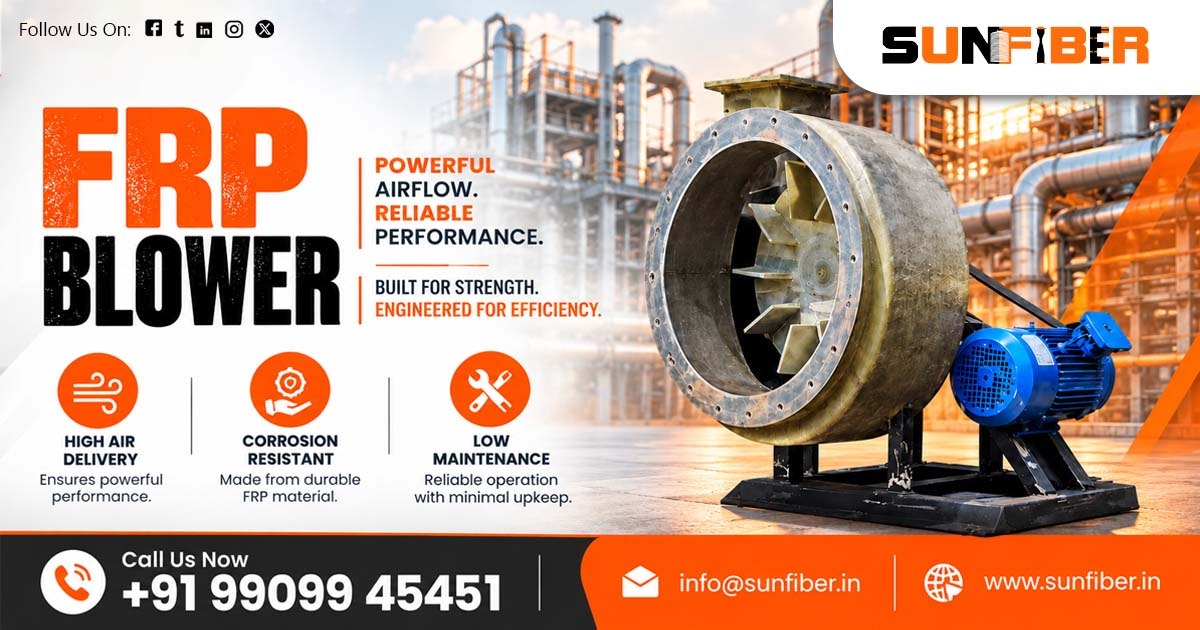
FRP blowers help industries manage corrosive fumes and process exhaust where conventional metal equipment may require careful corrosion protection. Businesses seeking an FRP Blower Supplier In West Bengal can consider Sunfiber for product selection and manufacturing support from Ahmedabad, Gujarat, India.
How FRP Blowers Support Corrosive Air Handling
An FRP (Fibre Reinforced Plastic) blower is designed to move air, fumes, or exhaust gases through industrial ventilation systems. Its suitability depends on the chemical composition, temperature, moisture level, and operating conditions of the exhaust stream.
Industries handling chemicals or corrosive vapours may need ventilation equipment that can withstand their specific working environment. An appropriately selected FRP blower can support fume extraction, process ventilation, and exhaust management when matched with the right system design.
Selecting a Blower for Your Plant Conditions
Before choosing an FRP blower, evaluate the operating requirements rather than selecting equipment based only on price.
- Airflow capacity: Calculate the required airflow according to the process and ventilation layout.
- Static pressure: Consider duct length, bends, filters, scrubbers, and other sources of resistance.
- Chemical compatibility: Confirm that the FRP resin and other exposed components suit the gases or vapours being handled.
- Temperature range: Check the normal and maximum operating temperatures against the blower’s specified limits.
- Installation space: Review available floor space, duct connections, access points, and maintenance clearance.
- Motor and power supply: Confirm motor rating, electrical supply, and operating requirements.
- Maintenance access: Ensure that inspection and servicing can be performed safely without major disruption.
A clear duty-point specification helps buyers compare suppliers on a consistent technical basis.
Understanding the FRP Blower Operating Process
An FRP blower moves air or process gases through a connected ventilation system. Its typical operating sequence is:
Step 1: Air or Fume Collection
Hoods or duct openings collect fumes from the process area.
Step 2: Airflow Generation
The blower impeller rotates and creates the pressure difference needed to move the gas stream.
Step 3: Exhaust Transfer
The gas travels through the duct network and may pass through a scrubber or another treatment unit, depending on the plant design.
Step 4: Controlled Discharge
The treated or extracted stream reaches its designated discharge point according to the system layout and applicable operating requirements.
Correct duct sizing, suitable materials, and appropriate system balancing are important for reliable performance.
Installation, Inspection, and Maintenance Planning
Proper installation helps reduce vibration, airflow problems, and avoidable equipment wear. Before commissioning, check the foundation or support structure, duct alignment, electrical connections, and the condition of the impeller and housing.
For ongoing maintenance, buyers should plan to:
- Inspect the blower housing and impeller for deposits, wear, or damage.
- Check vibration, unusual noise, and motor temperature during operation.
- Examine duct joints and connections for leakage.
- Follow the manufacturer’s maintenance schedule and isolate power before servicing.
If airflow drops unexpectedly, investigate blocked ducts, dirty impellers, incorrect rotation, or changes in system resistance before assuming the blower itself is faulty.
Quality Checks Before Confirming an Order
When comparing an FRP Blower Supplier In West Bengal, ask for clear technical information and verify the equipment against your actual process requirements.
- Review the specified airflow, static pressure, temperature limits, and motor rating.
- Confirm the FRP construction and chemical compatibility for the intended gas stream.
- Check blower dimensions, inlet and outlet sizes, and installation arrangements.
- Ask about inspection procedures, operating documentation, spare parts, and technical assistance.
- Clarify delivery timelines, commissioning responsibilities, and service arrangements before placing the order.
These checks help reduce the risk of selecting a blower that does not match the plant’s operating conditions.
Project-Specific Blower Requirements
Different industrial processes may need different blower configurations. Chemical concentration, exhaust temperature, required airflow, available space, and the presence of a scrubber can all influence equipment selection.
Share your process details and duct layout with the supplier before finalising the design. Any changes to materials, dimensions, or configuration should be confirmed against the manufacturer’s actual capabilities and technical specifications.
SERVICES
- FRP blower requirement assessment and product consultation
- Airflow, pressure, and material suitability guidance
- Installation planning and system integration coordination
- Maintenance guidance and technical support enquiries
Industrial Coverage Across West Bengal
Chemical processing, manufacturing, water treatment, and other industrial operations may require suitable fume extraction and ventilation equipment. Businesses evaluating an FRP Blower Supplier In West Bengal can assess their requirements across Kolkata, Howrah, Durgapur, Asansol, Siliguri, Haldia, Kharagpur, Barrackpore, Bidhannagar, Dankuni, Hooghly, Serampore, Raniganj, Kalyani, Malda, Burdwan, Midnapore, Bankura, Purulia, Jalpaiguri, Cooch Behar, Bolpur, Krishnanagar, Tamluk, and Uluberia.
How Sunfiber Can Assist With Your Requirement
Sunfiber supports industrial buyers evaluating FRP products for their process requirements. With manufacturing support from Ahmedabad, Gujarat, India, the company can be approached to discuss blower suitability, operating conditions, material requirements, and project specifications.
Visit Sunfiber to review the company’s product information and enquire about your application. Confirm the available blower model, technical specifications, delivery arrangements, and service scope directly with the company before ordering.
Frequently Asked Questions
Q: What information is needed to select an FRP blower?
A: Provide the required airflow, static pressure, gas composition, operating temperature, and duct layout. These details help establish whether a proposed blower suits your application.
Q: Can an FRP blower handle chemical fumes?
A: It may be suitable for certain corrosive fumes when the FRP resin and exposed components are chemically compatible. Confirm the gas composition and operating limits before purchase.
Q: What should be checked before installing an FRP blower?
A: Check the foundation, duct connections, electrical supply, airflow direction, and maintenance access. Follow the manufacturer’s installation instructions and safety procedures.
Q: How can I evaluate an FRP blower supplier for a West Bengal project?
A: Compare technical suitability, material details, documentation, delivery schedules, spare parts availability, and support arrangements rather than relying on price alone.
Conclusion
Selecting the right FRP blower requires careful evaluation of airflow, pressure, chemical compatibility, and installation conditions. Industrial buyers in West Bengal should confirm technical specifications and maintenance needs before ordering. Sunfiber, with manufacturing support from Ahmedabad, Gujarat, India, can be contacted to discuss relevant project requirements.
Contact Sunfiber through sunfiber.in to discuss your FRP blower requirements, application conditions, and product selection needs.
Phone: +91 99099 45451
Email: info@sunfiber.in
Feel free to contact us for more information and inquiries.
View Product: Click Here