When evaluating an HDPE Scrubber Supplier In Karnataka, buyers need more than a quoted price. Gas composition, temperature, chemical compatibility, airflow, installation space, and maintenance access all affect the suitability of the equipment. Sunfiber supports such requirements through manufacturing support from Ahmedabad, Gujarat, India.
Start With the Gas Stream, Not the Equipment Size
A scrubber should be selected around the process gas it needs to treat. Before requesting a quotation, the project team should identify:
- Gas or fume composition
- Expected gas flow
- Inlet temperature
- Presence of moisture or particulate matter
- Chemical concentration
- Required treatment arrangement
- Available installation space
- Operating conditions
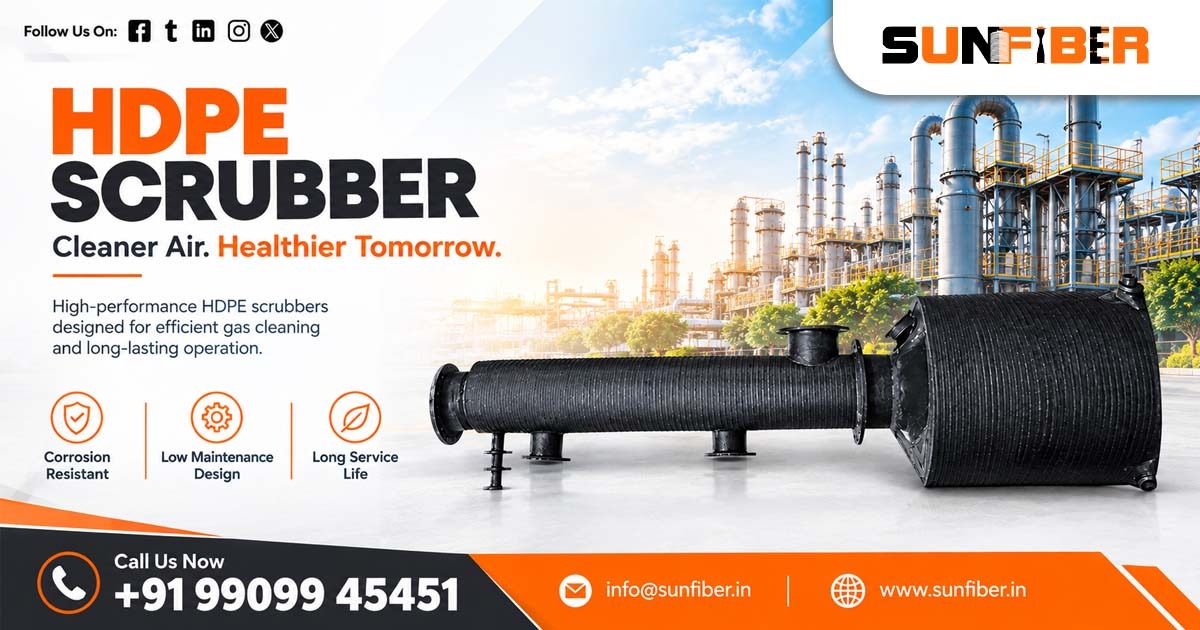
Sunfiber’s catalogue describes its HDPE/PP scrubbers as systems intended for treating gases, pollutants, chemicals and dust, with scrubber systems available along with associated equipment such as tanks, blowers and PP pumps.
Why HDPE Construction Needs Application-Based Evaluation
The buyer should discuss:
- Chemical compatibility
- Operating temperature
- Mechanical loading
- Gas characteristics
- Scrubbing-liquid chemistry
- Internal components and wetted parts
- Outdoor or indoor installation
The material should not be selected simply because a scrubber is required. The complete operating environment needs to be considered.
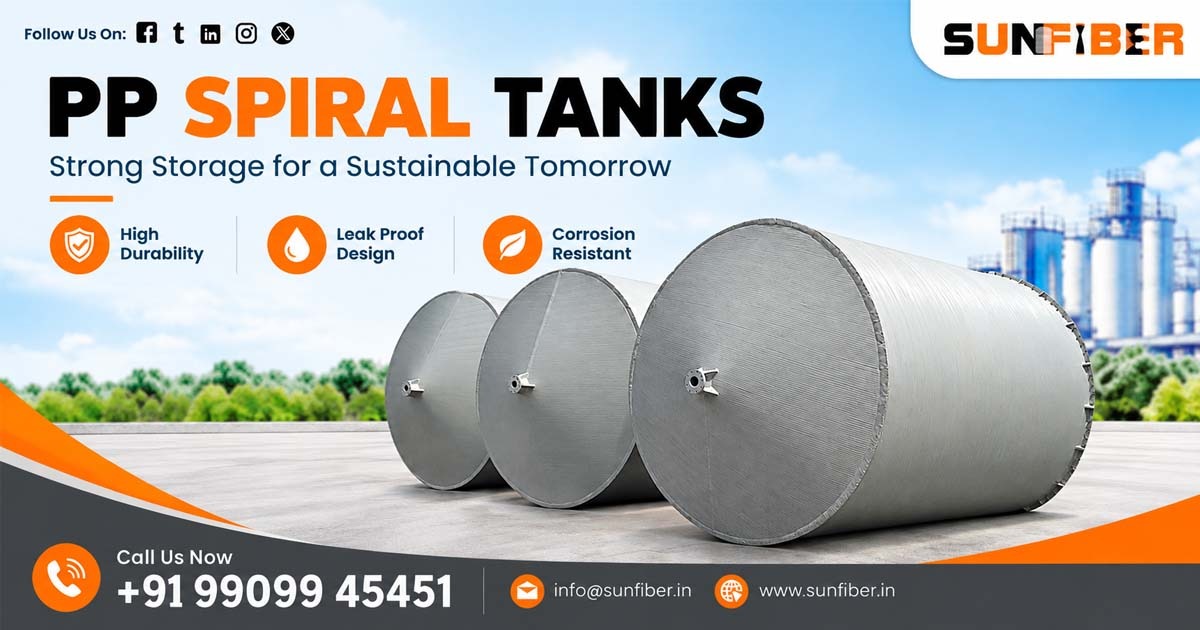
Sunfiber’s published product information includes HDPE/PP spiral scrubbers and identifies applications involving chemical and process industries, pharmaceuticals, food and beverages, textile processing and petrochemicals.
Understand What Happens Inside the Scrubber
A wet scrubber works by bringing the contaminated gas into contact with a suitable scrubbing liquid. Depending on the design and pollutant, contaminants can be absorbed, neutralized, or captured through gas-liquid contact.
A typical process can be understood as:
1 – Gas Entry:
Contaminated process gas enters the scrubber through the connected ducting.
2 – Gas-Liquid Contact:
The gas contacts the circulating or sprayed scrubbing liquid.
3 – Pollutant Transfer:
Target pollutants move into the liquid through absorption, chemical reaction, or particulate capture depending on the system design.
4 – Droplet Separation:
A suitable mist-elimination arrangement can help prevent liquid droplets from leaving with the treated gas.
5 – Gas Discharge:
The treated gas leaves through the outlet while the scrubbing liquid is collected for recirculation, treatment, or disposal as required.
The actual arrangement should be designed around the pollutant and process conditions rather than copied from another plant.
What Karnataka Buyers Should Put Into the RFQ
A clear enquiry can prevent repeated technical discussions later. When approaching an HDPE Scrubber Supplier In Karnataka, the RFQ should ideally include:
| Requirement | Information to Provide |
| Gas flow | Actual or estimated flow rate |
| Gas composition | Main gases, fumes or vapours |
| Temperature | Normal and maximum operating temperature |
| Pollutants | Target contaminants |
| Scrubbing liquid | Water or specified chemical solution |
| Installation | Indoor or outdoor location |
| Space | Available height and footprint |
| Ducting | Existing or proposed connection details |
| Electrical | Available supply and control requirements |
| Operation | Continuous or batch process |
| Maintenance | Access and inspection requirements |
This information gives the supplier a better basis for configuration and quotation.
Installation Should Be Planned Before Dispatch
Scrubber installation is not only about placing the vessel at the plant. The complete arrangement may involve ducting, blower, pump, tank, piping, electrical controls, access areas and discharge connections.
Before delivery, the project team should confirm:
- Equipment foundation or support arrangement
- Lifting and handling access
- Inlet and outlet duct positions
- Pump and piping locations
- Electrical connection points
- Maintenance access
- Drainage and liquid-handling arrangements
- Safe working clearance
- Connection to the existing process
Sunfiber’s published scrubber information indicates that its scrubbing systems can include the scrubber, tank, blower and PP pump, making system-level discussion relevant when planning the installation.
Routine Checks Can Prevent Process Interruptions
Maintenance requirements depend on the configuration and process, but routine inspection should form part of the operating plan.
Plant teams can monitor:
- Scrubber body condition
- Spray or liquid-distribution components
- Packing condition where applicable
- Mist eliminator condition
- Recirculation piping
- Pump operation
- Blower performance
- Fasteners and supports
- Leakage around connections
- Accumulation of solids or deposits
The scrubbing liquid should also be managed according to the process chemistry. Changes in liquid condition can affect the treatment process, so operating teams should follow the process-specific maintenance and operating instructions supplied with the system.
Three Checks Before Comparing Supplier Quotations
When comparing an HDPE Scrubber Supplier In Karnataka, procurement teams should avoid comparing only the equipment price.
1. Compare the proposed configuration
Check whether each quotation covers the same scope. One supplier may quote only the scrubber body, while another may include tanks, pumps, blowers, piping or controls.
2. Compare material and process suitability
Review the proposed material against the gas composition, chemical exposure and operating temperature. A cheaper material or configuration is not necessarily equivalent to another proposal.
3. Compare project support
Ask who will handle technical discussions, drawings, customization, installation guidance, commissioning coordination and spare-part requirements.
This makes the purchase comparison more meaningful than simply selecting the lowest quotation.
Planning the Requirement With Sunfiber
Sunfiber provides industrial plastic equipment and lists HDPE/PP spiral scrubbers among its product range. Its published company information places its manufacturing unit in Ahmedabad, Gujarat, India.
For Karnataka projects, buyers can discuss gas characteristics, required configuration, installation conditions and connected equipment before finalizing the requirement. The company website, sunfiber.in, can be used to review its product range and contact the team. Sunfiber can provide manufacturing support from Ahmedabad, Gujarat, India, for projects requiring equipment planning and industrial customization.
Services
- Process requirement discussion and scrubber configuration support
- HDPE/PP equipment selection based on operating conditions
- Project-specific fabrication and customization discussions
- Installation, commissioning coordination and technical assistance
Location
Industrial requirements for scrubbers can arise across Karnataka’s chemical, pharmaceutical, textile, engineering, food-processing and manufacturing clusters, including Bengaluru, Peenya, Bommasandra, Jigani, Bidadi, Doddaballapur, Harohalli, Mysuru, Mangaluru, Baikampady, Hubballi, Dharwad, Belagavi, Tumakuru, Narasapura, Kolar, Hassan, Shivamogga, Davangere, Ballari, Raichur, Kalaburagi, Vijayapura, Udupi and Hosapete.
FAQs
Q: What information should I provide when ordering an HDPE scrubber?
A: Share the gas composition, flow rate, temperature, pollutants, scrubbing-liquid details, installation conditions and available space. These details help the supplier evaluate the appropriate configuration.
Q: How do I compare two scrubber quotations?
A: Compare material, configuration, gas-flow basis, connected equipment, project scope, documentation, installation support and maintenance requirements rather than comparing only the quoted price.
Q: Does scrubber maintenance depend on the process?
A: Yes. Inspection and cleaning requirements can vary with gas composition, solids, chemical loading, scrubbing liquid and operating conditions. A process-specific maintenance plan is preferable to a generic schedule.
Conclusion
Selecting an industrial scrubber for a Karnataka plant should begin with the process conditions and continue through material selection, equipment configuration, installation and maintenance planning. Sunfiber can discuss these requirements and provide manufacturing support from Ahmedabad, Gujarat, India, for suitable industrial projects.
Share your gas-treatment requirement with Sunfiber to discuss the appropriate scrubber configuration, project conditions and technical requirements.
Phone: +91 99099 45451
Email: info@sunfiber.in
Feel free to contact us for more information and inquiries.
View Product: Click Here