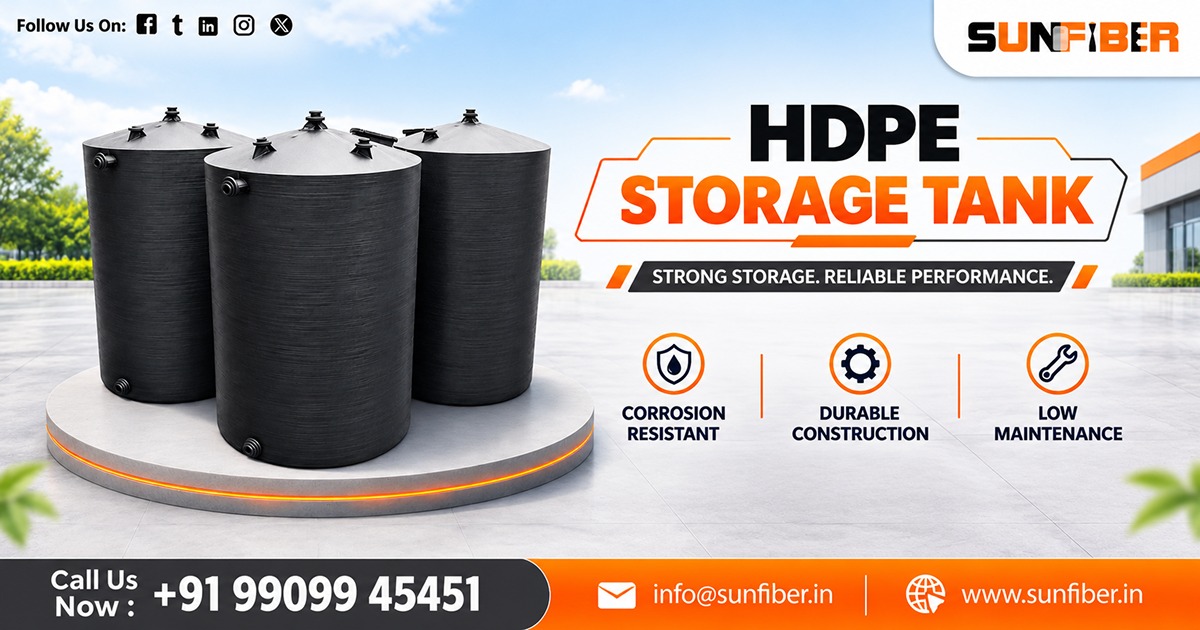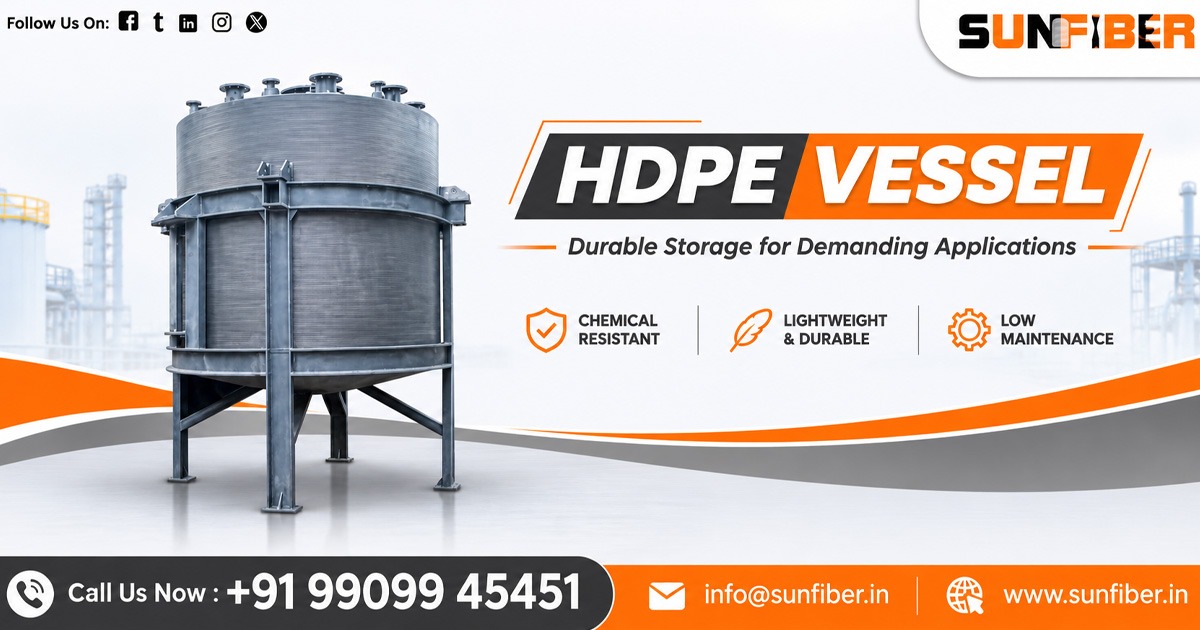
Industrial plants handling chemicals, process liquids, and water-treatment materials need storage equipment suited to their operating conditions. A Corrosion-Resistant HDPE Vessel for Industrial Process Storage helps address material compatibility concerns, with Sunfiber providing manufacturing support from Ahmedabad, Gujarat, India.
Why Material Selection Matters When Storing Industrial Chemicals
Industrial storage vessels remain in contact with liquids for extended periods. If the vessel material is unsuitable for the stored substance, the plant may face leakage concerns, material deterioration, contamination, or additional maintenance requirements.
High-Density Polyethylene (HDPE) is a thermoplastic material commonly considered for industrial storage because of its chemical resistance and moisture resistance.
Before selecting an HDPE vessel, buyers should evaluate:
- Chemical Compatibility: Confirm whether the HDPE grade is suitable for the specific chemical, concentration, and storage temperature.
- Corrosion Exposure: Consider the stored liquid and surrounding operating environment.
- Storage Conditions: Review indoor or outdoor installation, temperature variations, and exposure conditions.
- Cleaning Requirements: Understand how frequently the vessel needs cleaning and which cleaning agents will be used.
The material should always be selected according to the actual process requirements rather than general chemical-resistance assumptions.
Matching Vessel Capacity With Your Plant’s Storage Requirement
An oversized or undersized vessel can create unnecessary operational difficulties. Capacity planning should consider both current consumption and future production requirements.
Important points to evaluate include:
- Daily Liquid Consumption: Estimate how much material the production process uses during a normal operating shift.
- Storage Duration: Determine whether the vessel will support short-term process storage or longer holding periods.
- Working Capacity: Consider the required usable storage volume while allowing suitable headspace.
- Process Demand: Check whether liquid withdrawal happens continuously, periodically, or in batches.
- Future Expansion: Account for possible increases in production or additional process requirements.
For example, a chemical-processing plant with regular liquid consumption may need a vessel that supports its dosing, transfer, and replenishment schedule without interrupting the production workflow.
Technical Details That Influence HDPE Vessel Performance
The suitability of an HDPE storage vessel depends on more than its nominal capacity. Its construction and configuration must match the intended installation and operating conditions.
Buyers should discuss the following details with the manufacturer:
| Technical consideration | What to verify |
| Vessel capacity | Required storage volume and usable capacity |
| Material grade | HDPE suitability for the stored liquid |
| Wall thickness | Design suitability for vessel dimensions and operating conditions |
| Shape and dimensions | Available installation space and layout |
| Inlet and outlet | Liquid filling and discharge requirements |
| Nozzle connections | Compatibility with existing pipelines |
| Top opening | Filling, inspection, and cleaning access |
| Support arrangement | Base support and installation requirements |
For applications involving higher temperatures, significant liquid density, or unusual operating conditions, the vessel design requires additional technical assessment.
Where HDPE Storage Vessels Fit Into Industrial Processes
Industrial plants use storage vessels at different stages of material handling. Their position in the process depends on the type of liquid, production sequence, and transfer arrangement.
Common industrial requirements include:
- Chemical Processing: Holding compatible process chemicals before they are transferred to mixing or production equipment.
- Water Treatment: Storing suitable treatment liquids used during water-processing operations.
- Textile Manufacturing: Maintaining storage arrangements for compatible processing chemicals and liquid preparations.
- Agricultural Processing: Supporting storage requirements for selected liquid materials.
- General Manufacturing: Providing intermediate storage between material preparation and the next production stage.
The vessel should be positioned according to the process flow, with suitable connections for filling, discharge, and inspection.
Installation Planning Before Bringing the Vessel Into Operation
Even a correctly selected vessel can create operational problems if its installation location is unsuitable.
Before installation, the plant team should review:
- Foundation Preparation: Provide a level, stable, and adequately designed supporting surface.
- Space Assessment: Check the vessel dimensions, access routes, and surrounding equipment.
- Pipeline Alignment: Position inlet and outlet connections according to the existing liquid-transfer arrangement.
- Maintenance Access: Leave sufficient space for inspection, cleaning, and connection servicing.
- Safety Planning: Consider chemical handling procedures, spill management, and access restrictions.
- Commissioning Checks: Inspect connections, supports, and the installation arrangement before introducing the process liquid.
The vessel must be designed for its intended service. Standard atmospheric storage vessels should not be assumed suitable for pressurised or vacuum applications.
Inspection Practices That Help Maintain Storage Reliability
Regular inspection helps plant operators identify developing issues before they interfere with normal storage activities.
A practical inspection routine should cover:
- External Surface: Look for cracks, deformation, unusual bulging, or visible damage.
- Connections: Examine inlet, outlet, flange, and nozzle areas for leakage.
- Supporting Structure: Check whether the base and supporting arrangement remain stable.
- Internal Condition: Inspect for deposits, contamination, or material accumulation where accessible.
- Cleaning Procedure: Use cleaning methods and agents compatible with the HDPE material.
- Operating Records: Maintain information about stored chemicals, inspection findings, and maintenance activities.
If deformation, leakage, or unexpected changes are noticed, the vessel should be assessed by qualified technical personnel before further use.
Services
Sunfiber can be approached to discuss industrial vessel requirements and related manufacturing considerations.
- HDPE Vessel Manufacturing: Vessel fabrication planning according to the required industrial storage application.
- Storage Capacity Assessment: Understanding the required volume, dimensions, and plant storage arrangement.
- Vessel Configuration Support: Discussing suitable openings, connections, and liquid transfer requirements.
- Industrial Project Coordination: Technical discussions related to product selection and installation planning.
Industrial Storage Requirements Across Gujarat
Ahmedabad’s chemical, pharmaceutical, textile, and manufacturing sectors create varied requirements for industrial liquid storage equipment. Sunfiber supports industrial requirements from Ahmedabad, Gujarat, India, with relevant locations including Ahmedabad, Sanand, Changodar, Bavla, Vatva, Naroda, Odhav, Kathwada, Moraiya, Chhatral, Kalol, Gandhinagar, Mehsana, Kadi, Vadodara, Ankleshwar, Bharuch, Dahej, Vapi, Valsad, Surat, Rajkot, Jamnagar, and Bhavnagar.
Planning Your HDPE Storage Requirement With Sunfiber
Industrial vessel selection involves understanding the stored material, operating environment, storage volume, and installation arrangement. Sunfiber provides manufacturing support from Ahmedabad, Gujarat, India, through its website, sunfiber.in.
Industrial buyers can discuss their application requirements, vessel configuration, and project considerations before finalising an order. Clear technical communication helps ensure that the selected storage arrangement is appropriate for the intended process.
Frequently Asked Questions
Q1. What makes HDPE suitable for industrial chemical storage?
A: HDPE offers resistance to many chemicals and moisture. However, suitability depends on the chemical type, concentration, temperature, and storage conditions.
Q2. How do I determine the correct capacity for an HDPE vessel?
A: Consider daily liquid consumption, storage duration, replenishment frequency, and future production requirements. Also account for the necessary headspace above the working liquid level.
Q3. Can HDPE vessels be connected directly to existing industrial pipelines?
A: Yes, suitable inlet and outlet connections can be considered during vessel configuration. Connection sizes, fittings, pipeline compatibility, and installation arrangements should be confirmed beforehand.
Q4. What should be checked before ordering a corrosion-resistant HDPE vessel?
A: Verify material compatibility, storage capacity, dimensions, wall construction, connection requirements, installation conditions, and inspection access with the manufacturer.
Conclusion
A suitable industrial storage vessel starts with understanding the liquid being stored and the conditions under which it will operate. Material compatibility, capacity, construction, and installation planning all influence purchasing decisions. Industrial buyers in Ahmedabad and across Gujarat can discuss their requirements with Sunfiber before finalising a storage arrangement.
Discuss your industrial liquid storage requirements with Sunfiber to evaluate a suitable HDPE vessel configuration.
Phone: +91 99099 45451
Email: info@sunfiber.in
Feel free to contact us for more information and inquiries.
View Product: Click Here