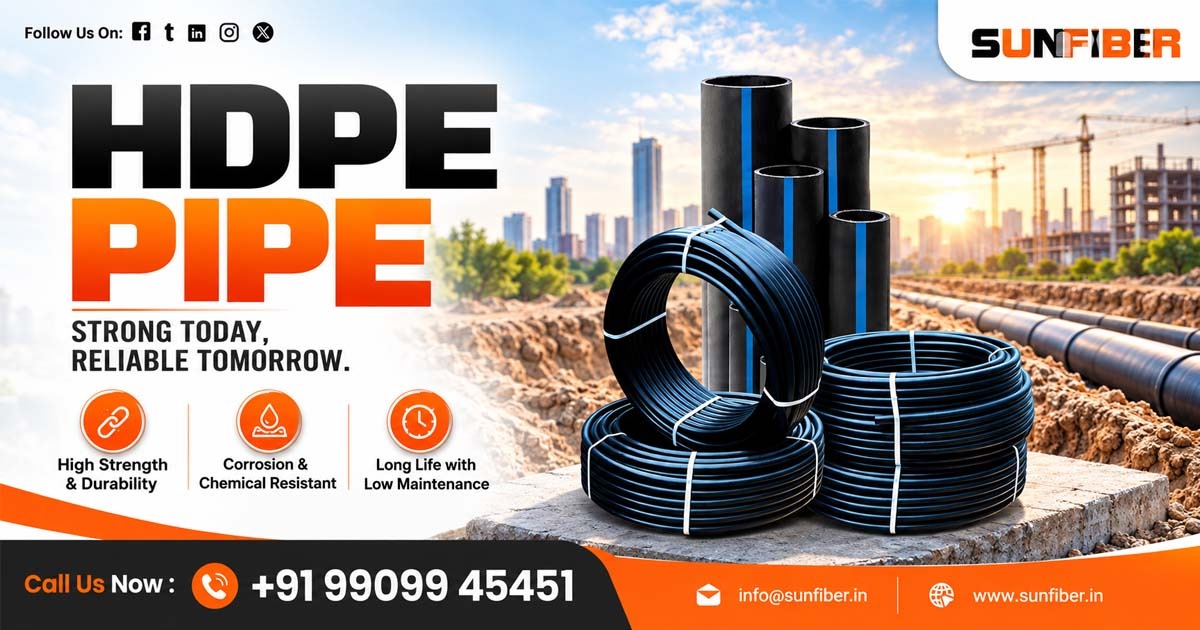
Selecting the right HDPE Pipe Supplier In Bihar is important for projects requiring dependable water transportation, irrigation networks and industrial piping. Sunfiber supports buyers with HDPE piping solutions and manufacturing support from Ahmedabad, Gujarat, India.
Understanding HDPE Pipes for Bihar’s Infrastructure and Industrial Requirements
High-Density Polyethylene (HDPE) pipes are manufactured using thermoplastic polyethylene material designed for fluid transportation and distribution systems. Their combination of flexibility, impact resistance and corrosion resistance makes them suitable for several infrastructure and industrial projects.
Unlike conventional metal pipelines, HDPE pipes do not rust or develop corrosion-related deterioration. Their flexible construction also helps accommodate certain ground movements when the pipeline is properly designed and installed.
For businesses searching for an HDPE Pipe Supplier In Bihar, these pipes can be considered for projects involving:
- Water Distribution: Transportation of water across residential, commercial and municipal networks.
- Agricultural Irrigation: Supplying water to agricultural fields, irrigation channels and distribution systems.
- Industrial Piping: Moving compatible liquids between industrial processing areas.
- Sewage and Drainage: Supporting wastewater transportation infrastructure.
- Cable Protection: Providing protective ducts for underground electrical and communication cables.
- Infrastructure Development: Supporting utility networks and pipeline installation projects.
The correct pipe selection depends on the transported material, operating pressure, installation environment and project requirements.
How to Select HDPE Pipes for Different Applications
Not every piping project requires the same diameter, pressure rating or pipe configuration. Selecting an unsuitable product can affect water flow, joint reliability and overall installation costs.
Before purchasing, evaluate the following factors:
| Selection Factor | What Buyers Should Check |
| Pipe Diameter | Match the internal flow requirement and expected water volume. |
| Pressure Rating | Select an appropriate pressure class according to operating conditions. |
| Material Grade | Check the polyethylene grade and material suitability. |
| Pipe Thickness | Verify wall thickness in relation to diameter and pressure requirements. |
| Installation Method | Consider underground, above-ground or industrial installation conditions. |
| Pipe Length | Decide between coil and straight-length requirements. |
| Joint Compatibility | Confirm compatibility with fittings and joining equipment. |
| Operating Environment | Evaluate temperature, soil conditions and exposure to chemicals. |
A practical purchasing recommendation: Share the pipeline layout, required flow rate, operating pressure and application details with the supplier before finalising the order.
This helps reduce the possibility of selecting pipes that are either unsuitable or unnecessarily oversized.
From Pipe Delivery to Commissioning: Understanding the Installation Process
HDPE pipeline installation involves several connected activities. Proper planning and joint preparation are important for maintaining the performance of the complete network.
Step 1: Site Assessment and Pipeline Planning
Identify the pipeline route, installation depth, water source, delivery points and expected operating pressure.
Check the site for obstacles, soil conditions and possible external loading.
Step 2: Pipe and Fitting Arrangement
Arrange pipes, bends, tees, reducers, valves and other required components according to the approved pipeline layout.
Verify dimensions and compatibility before starting installation.
Step 3: Pipe Joining and Connection
HDPE pipes can be connected using suitable joining methods, including:
- Butt fusion welding
- Electrofusion welding
- Mechanical compression fittings
The joining method should match the pipe dimensions, application and installation requirements. Fusion joints require properly prepared surfaces, suitable equipment and controlled welding procedures.
Step 4: Inspection and Pressure Testing
After installation, inspect the joints, connections and pipeline alignment.
Conduct appropriate pressure testing according to the project specifications before putting the system into regular operation.
Quality Checks Buyers Should Complete Before Ordering
When evaluating an HDPE Pipe Supplier In Bihar, customers should look beyond the quoted price. Product suitability and consistency are equally important for long-term pipeline performance.
Consider these purchasing checks:
- Raw Material: Ask about the polyethylene grade and material traceability.
- Dimensions: Verify outside diameter, wall thickness and dimensional tolerances.
- Pressure Classification: Confirm that the selected pressure rating matches the design requirement.
- Surface Inspection: Check for visible cracks, uneven surfaces, deformation and manufacturing defects.
- Product Documentation: Request available technical specifications and relevant test documentation.
- Fitting Compatibility: Confirm that the proposed fittings match the selected pipe dimensions.
- Delivery Planning: Discuss order quantities, transportation arrangements and delivery schedules.
- Technical Assistance: Understand what support is available during product selection and installation planning.
For large infrastructure projects, it is also advisable to maintain proper records of supplied pipe batches and inspection details.
Maintenance Practices That Help Protect HDPE Pipeline Performance
Although HDPE piping generally requires limited routine maintenance, regular inspection helps identify potential problems before they interrupt operations.
Some useful maintenance practices include:
- Inspect exposed pipelines for physical damage and unusual deformation.
- Check joints and fittings for leakage.
- Monitor pressure variations within the pipeline.
- Keep valves and accessible connections in working condition.
- Remove external loads that could damage exposed pipe sections.
- Investigate unexpected reductions in water flow.
- Inspect underground pipeline sections when leakage or operational issues are suspected.
Common troubleshooting situations:
| Problem | Possible Reason | Recommended Action |
| Water leakage | Improper joint connection | Inspect and repair the affected joint. |
| Reduced flow | Blockage or unsuitable pipe sizing | Check the pipeline and flow conditions. |
| Joint failure | Incorrect fusion procedure | Review joining parameters and workmanship. |
| Pipe deformation | Excessive external loading | Inspect installation and support conditions. |
Correct installation and timely maintenance can help reduce avoidable pipeline interruptions.
Services
Sunfiber can support customers with the following product-related requirements:
- HDPE pipe and fitting selection according to application requirements.
- Product consultation and technical requirement assessment.
- Coordination of pipe and fitting requirements for project procurement.
- Assistance with product-related queries and after-sales support.
Location
Bihar has growing requirements for agricultural irrigation, municipal water distribution, industrial development and infrastructure projects. HDPE piping solutions can support these activities across Patna, Gaya, Muzaffarpur, Bhagalpur, Darbhanga, Purnia, Begusarai, Bihar Sharif, Ara, Munger, Chhapra, Samastipur, Hajipur, Katihar, Motihari, Bettiah, Siwan, Buxar, Sasaram, Dehri, Kishanganj, Jamalpur, Jehanabad, Sitamarhi and Madhubani.
How Sunfiber Supports HDPE Pipe Procurement Requirements
Choosing a suitable supplier involves understanding the application, identifying the correct pipe configuration and coordinating product requirements before procurement.
Sunfiber provides HDPE, PPRC, uPVC, PVC and FRP pipes and fittings as part of its broader industrial product range. The company also supplies industrial engineering products and fabricated components.
With manufacturing support from Ahmedabad, Gujarat, India, Sunfiber works with customers across different Indian markets to understand their product and project requirements.
Customers can explore the company’s product range and submit enquiries through its official website: Sunfiber – Official Website.
Frequently Asked Questions (FAQ)
Q1: What information should I provide when requesting an HDPE pipe quotation?
A: Share the required diameter, pressure rating, quantity, pipe length and application details. The installation location and fitting requirements will also help the supplier prepare a suitable quotation.
Q2: Are HDPE pipes suitable for agricultural irrigation projects in Bihar?
A: Yes. HDPE pipes are commonly considered for irrigation networks because of their flexibility, corrosion resistance and suitability for water transportation when correctly specified.
Q3: Which joining method is suitable for HDPE pipelines?
A: Butt fusion, electrofusion and mechanical compression connections are commonly used. The appropriate method depends on pipe dimensions, system design and installation conditions.
Q4: How can I reduce maintenance problems in an HDPE pipeline?
A: Select the correct pressure rating, use compatible fittings, ensure proper joint installation and conduct periodic inspections to identify leakage, damage or unusual pressure changes.
Conclusion
Choosing the right HDPE Pipe Supplier In Bihar requires attention to pipe dimensions, pressure ratings, material quality and installation requirements. HDPE piping offers a practical solution for irrigation, water distribution and industrial networks. Sunfiber provides product procurement support with manufacturing support from Ahmedabad, Gujarat, India.
Contact Sunfiber through its official website to discuss your HDPE pipe requirements, product selection and project-specific procurement needs.
Phone: +91 99099 45451
Email: info@sunfiber.in
Feel free to contact us for more information and inquiries.
View Product: Click Here