Industrial pipelines handling chemicals, wastewater, and process liquids require suitable flow-control components. Finding a dependable PP Valve Supplier In Chhattisgarh helps industries select polypropylene valves according to fluid compatibility, pipeline design, and operating conditions. Sunfiber supports industrial valve requirements with manufacturing support from Ahmedabad, Gujarat, India.
Understanding the Role of Polypropylene Valves in Industrial Pipelines
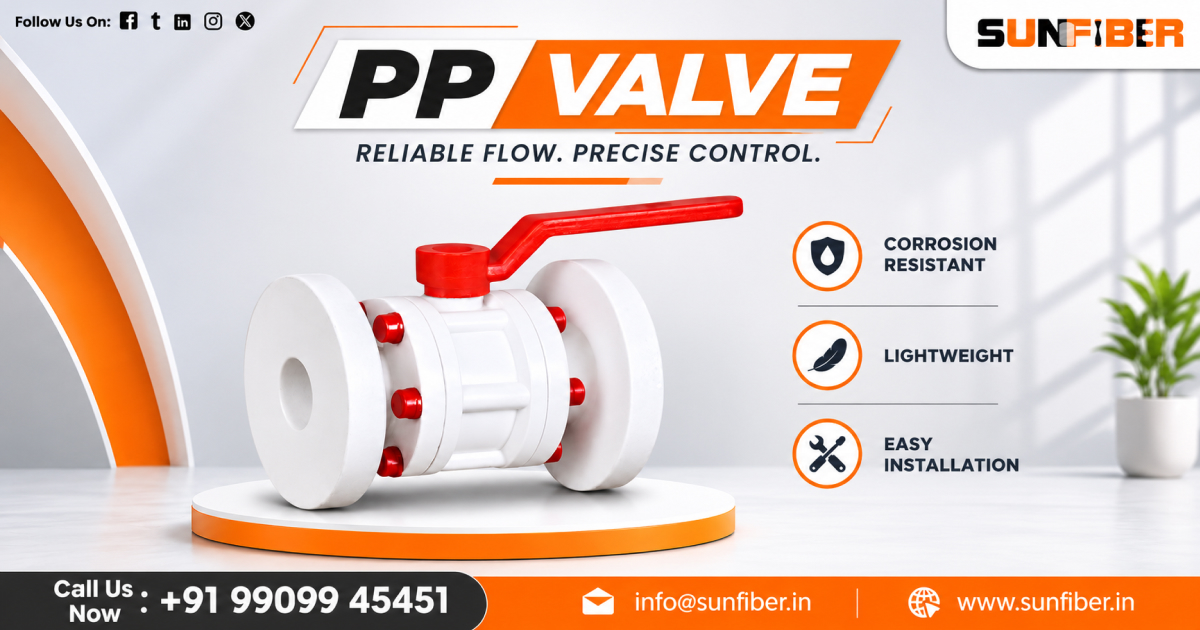
A Polypropylene (PP) valve is a flow-control component manufactured using polypropylene material. It regulates, starts, stops, or controls liquid movement through connected pipelines.
PP valves are considered for systems where resistance to chemical corrosion and reduced dependence on metallic components are important.
Where can PP valves be useful?
- Chemical Processing: Controlling the movement of compatible acids, alkalis, and process chemicals.
- Water Treatment: Managing water flow in treatment and distribution lines.
- Wastewater Plants: Controlling liquid movement in treatment and collection systems.
- Pharmaceutical Units: Supporting suitable liquid-transfer arrangements.
- Textile Processing: Managing process liquids in chemical preparation and treatment sections.
- Fertilizer Plants: Supporting compatible chemical handling operations.
The valve must always be selected according to the chemical concentration, temperature, pressure, and operating conditions.
What Should Buyers Check Before Selecting a PP Valve?
Choosing a valve only by its nominal pipe size can create operational problems. Buyers should evaluate the complete pipeline requirement before confirming an order.
| Selection factor | What to evaluate |
| Valve type | Ball, butterfly, diaphragm, or non-return valve |
| Material compatibility | Suitability of PP for the handled liquid |
| Pipeline size | Matching connection dimensions |
| Operating pressure | Maximum working pressure required |
| Temperature | Normal and maximum fluid temperature |
| Connection type | Threaded, flanged, or other suitable connections |
| Flow requirement | Required flow rate and pressure drop |
| Operating frequency | Manual or automated operation |
| Maintenance | Accessibility of internal components and seals |
Important: Polypropylene is not suitable for every chemical or operating temperature. Always obtain material compatibility and pressure-temperature information before purchasing.
How Does a PP Valve Control Liquid Flow?
The operating mechanism depends on the selected valve design. A ball valve, for example, uses a rotating ball with an internal opening to control liquid movement.
The general operation involves the following steps:
Step 1: Pipeline Connection
The valve is connected to the pipeline using the specified connection arrangement. Proper alignment helps avoid unnecessary stress.
Step 2: Flow Regulation
The operator moves the handle or operating mechanism to change the valve position.
Step 3: Liquid Movement
When the valve is open, liquid passes through its internal flow passage. When closed, the sealing arrangement restricts the flow.
Step 4: Inspection and Operation
The operator checks for leakage, smooth movement, and proper sealing during routine operation.
Different designs have different operating mechanisms. For example, a non-return valve automatically responds to flow direction rather than requiring regular manual operation.
Quality Checks That Matter Before Ordering Industrial Valves
A suitable valve should match the actual process conditions rather than simply meeting a general purchasing specification.
Before finalizing an order, buyers should verify:
- Body Material: Confirm that the valve body is made from the specified polypropylene grade.
- Internal Components: Check the material of the ball, stem, seat, and sealing elements.
- Dimensional Accuracy: Verify valve size and pipeline connection measurements.
- Pressure Rating: Confirm the permissible working pressure for the operating temperature.
- Leakage Inspection: Ask about the inspection and testing procedure.
- Handle Operation: Check whether the operating mechanism moves properly.
- Product Identification: Verify the model, size, and material details.
- Documentation: Request available technical specifications and product information.
These checks help reduce the possibility of incorrect selection, leakage, and unnecessary replacement.
Installation and Maintenance: Details That Should Not Be Overlooked
Correct installation helps maintain valve performance and reduces avoidable pipeline issues.
Installation considerations:
- Match the valve connection with the pipeline arrangement.
- Maintain proper alignment during installation.
- Avoid excessive tightening of threaded connections.
- Provide sufficient space for handle movement and inspection.
- Follow the manufacturer’s installation instructions.
- Check the system for leakage before regular operation.
Routine maintenance practices:
- Inspect the valve body and connections for visible damage.
- Check for leakage around joints and sealing areas.
- Operate manual valves periodically where appropriate.
- Remove accumulated deposits when required.
- Replace damaged sealing components with compatible parts.
- Investigate stiff operation instead of applying excessive force.
Common operating problems and possible checks:
| Problem | What to inspect |
| Leakage at connections | Threading, flange alignment, and sealing |
| Difficult handle movement | Internal deposits or component wear |
| Incomplete flow | Valve opening and pipeline blockage |
| Poor shut-off | Seat condition and foreign particles |
Services
- Industrial PP valve requirement consultation and product selection.
- Pipeline connection and material compatibility assessment.
- Technical specification and application-based product guidance.
- Maintenance coordination and technical assistance for industrial valve requirements.
PP Valve Requirements Across Chhattisgarh
Chemical processing, steel production, power generation, water treatment, pharmaceutical manufacturing, and other industrial activities create demand for suitable pipeline flow-control components. Businesses looking for a PP Valve Supplier In Chhattisgarh should evaluate material compatibility and operating requirements before selecting products.
Relevant industrial and commercial locations include Raipur, Bhilai, Durg, Korba, Bilaspur, Raigarh, Dhamtari, Jagdalpur, Ambikapur, Rajnandgaon, Kawardha, Mahasamund, Kanker, Janjgir, Champa, Tilda, Urla Industrial Area, Siltara Industrial Area, Sirgitti Industrial Area, Borai Industrial Area, Hathkhoj Industrial Area, Bhanpuri, Kumhari, and Saraipali.
How Sunfiber Supports Industrial Valve Requirements
Selecting a suitable supplier involves more than checking product availability. Buyers also need clear communication about valve specifications, material suitability, and application requirements.
Sunfiber works with industrial product requirements across different sectors and offers a range of pipeline and instrumentation valves in different material options. Its website also describes its industrial valve range and related products.
SunFiber+1
With manufacturing support from Ahmedabad, Gujarat, India, Sunfiber can help customers discuss their valve requirements and identify suitable product options.
For product details and enquiries, visit the official website: https://sunfiber.in/.
Frequently Asked Questions (FAQs)
Q1: What is the main purpose of a PP valve?
A: A PP valve controls the movement of liquids through industrial pipelines. It can be used for starting, stopping, or regulating flow according to its design.
Q2: Can polypropylene valves handle corrosive chemicals?
A: PP valves can handle many compatible acids and alkalis. However, suitability depends on chemical concentration, temperature, pressure, and the material grade.
Q3: How do I select the correct PP valve size?
A: Consider the pipeline diameter, required flow rate, connection type, and operating pressure. The valve dimensions should match the pipeline design.
Q4: What maintenance is required for industrial PP valves?
A: Regular inspection of connections, sealing components, valve movement, and visible damage is important. Maintenance frequency depends on operating conditions and fluid characteristics.
Conclusion
Selecting the right valve helps industries maintain controlled liquid movement and avoid unnecessary pipeline problems. Businesses evaluating a PP Valve Supplier In Chhattisgarh should consider material compatibility, pressure ratings, connection dimensions, and maintenance requirements. Sunfiber offers industrial product support with manufacturing support from Ahmedabad, Gujarat, India.
Contact Sunfiber through sunfiber.in to discuss your industrial valve requirements and obtain product-related technical guidance.
Phone: +91 99099 45451
Email: info@sunfiber.in
Feel free to contact us for more information and inquiries.
View Product: Click Here