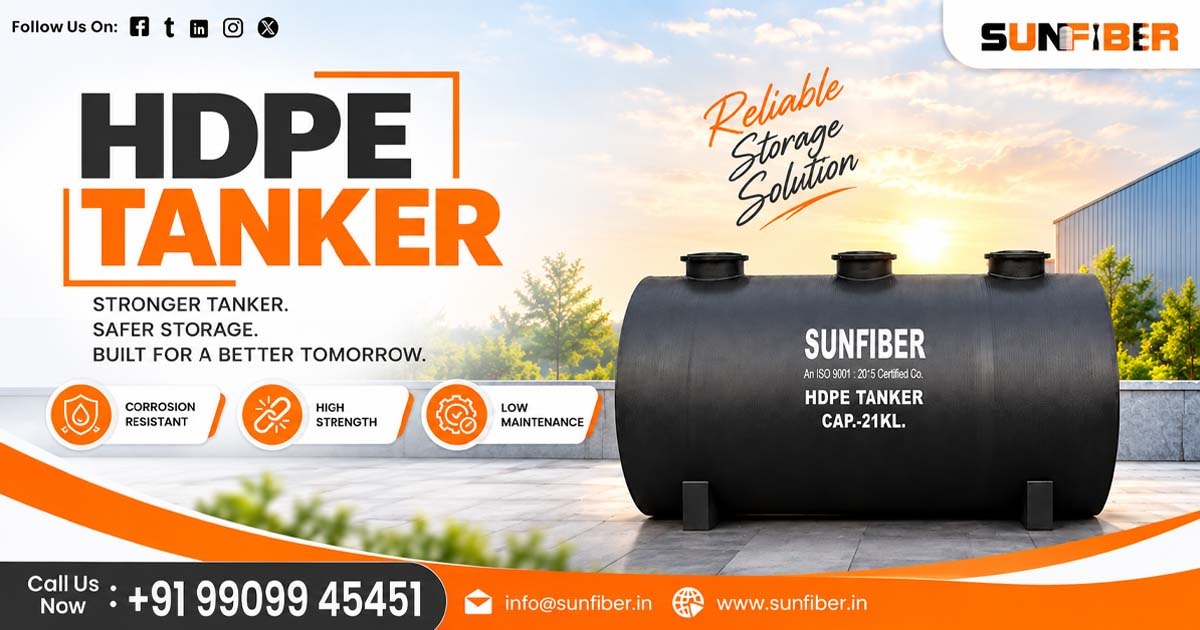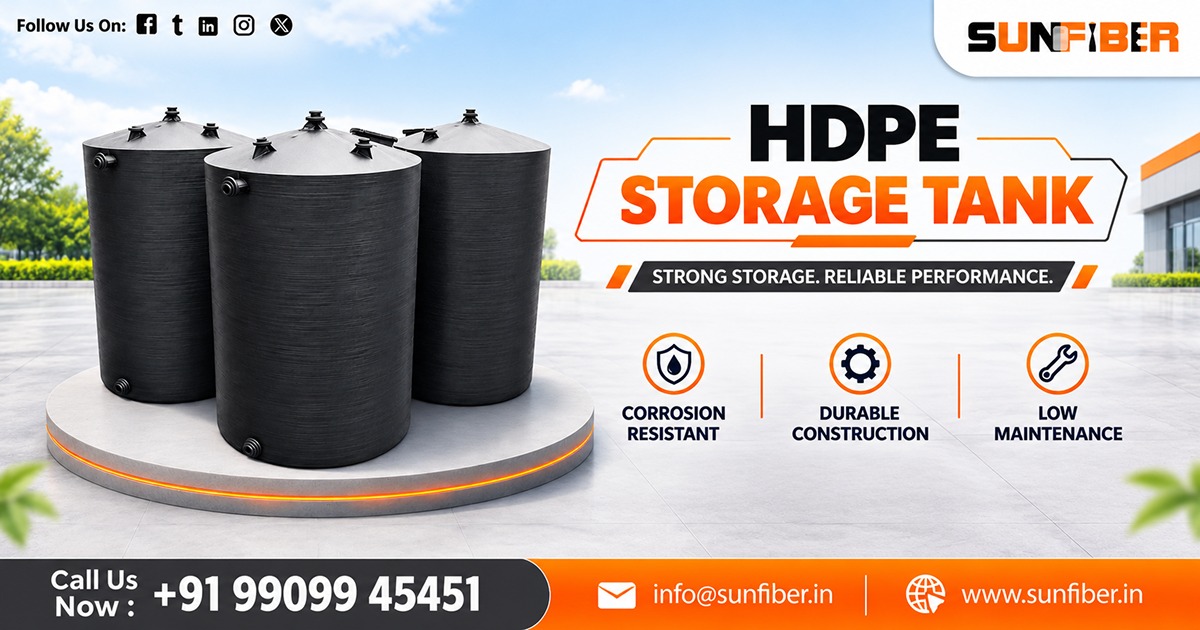
Industrial liquid storage requires tanks that can handle the stored material, operating conditions, and daily handling requirements. High-Quality HDPE Tanks for Industrial Liquid Storage offer a practical storage option for industries seeking suitable plastic tank solutions. Sunfiber provides manufacturing support from Ahmedabad, Gujarat, India.
Understanding HDPE Tanks for Industrial Storage Requirements
Industrial facilities may use these tanks for:
- Chemical Storage: Holding compatible industrial chemicals and process liquids.
- Water Storage: Storing process water, utility water, and other suitable liquids.
- Effluent Handling: Temporary storage of compatible wastewater and treatment liquids.
- Production Operations: Supplying liquids to manufacturing and processing equipment.
- Utility Management: Maintaining liquid reserves for regular industrial activities.
How to Select an HDPE Tank for Your Industrial Facility
Selecting a tank involves more than checking its storage capacity. Buyers should evaluate the following technical and operational requirements before finalising an order.
| Selection factor | What buyers should check |
| Storage capacity | Required volume and expected liquid consumption |
| Chemical compatibility | Suitability of HDPE for the stored liquid |
| Tank dimensions | Available installation space and site layout |
| Liquid temperature | Normal and maximum operating temperature |
| Wall construction | Wall thickness and structural suitability |
| Tank design | Vertical, horizontal, or other suitable configuration |
| Fittings and connections | Inlet, outlet, drain, and vent requirements |
| Installation location | Indoor, outdoor, foundation, and access conditions |
| Maintenance | Cleaning access and inspection requirements |
| Future demand | Possibility of increased storage requirements |
Important: Do not select a tank based only on its advertised capacity. The stored liquid, specific gravity, temperature, and installation conditions can influence the required tank design.
How Spiral-Wound HDPE Tanks Are Manufactured and Prepared for Use
The general manufacturing and preparation process involves:
Step 1: Raw Material Selection
HDPE material is selected according to the intended application, chemical exposure, and operating requirements.
Step 2: Spiral Winding
The HDPE strip is applied around a heated rotating mandrel. Each layer is fused with the previous layer to build the cylindrical tank structure.
Step 3: Base and Fitting Fabrication
The tank base is joined to the body using suitable welding techniques. Required connections, openings, and accessories are incorporated according to the design.
Step 4: Inspection and Installation Preparation
The completed tank should be inspected for dimensions, joints, surface condition, and connection requirements before dispatch and installation.
What Buyers Should Verify Before Ordering an HDPE Storage Tank
A storage tank becomes part of an industrial facility’s daily operations. Therefore, purchasing decisions should consider both product quality and the actual storage environment.
Important pre-purchase checks:
- Raw Material: Confirm the HDPE grade and material suitability for the intended liquid.
- Wall Thickness: Check whether the tank construction is appropriate for the liquid density and storage height.
- Weld Quality: Examine joints, seams, and base connections for proper fabrication.
- Capacity and Dimensions: Match the usable volume with the required storage quantity.
- Chemical Compatibility: Verify compatibility with the exact chemical, including its concentration and temperature.
- Structural Support: Confirm the foundation and supporting surface can handle the filled tank’s weight.
- Documentation: Request relevant product specifications, drawings, and inspection details.
- Delivery Planning: Check transportation access, unloading arrangements, and installation requirements.
Installation and Maintenance Points
Proper installation and routine inspection help maintain storage system reliability.
- Install the tank on a properly prepared, level foundation.
- Keep the tank accessible for inspection and cleaning.
- Use compatible pipes, valves, gaskets, and fittings.
- Avoid unapproved modifications or excessive loads on tank connections.
- Inspect joints, outlets, supports, and visible surfaces periodically.
- Clean the tank using methods compatible with its material and stored liquid.
- Investigate leakage, deformation, or unusual movement before continuing normal operation.
Common operating problems to watch for:
| Problem | Recommended action |
| Leakage around connections | Inspect fittings, seals, and joints |
| Tank deformation | Review liquid density, filling level, and support |
| Difficult liquid discharge | Check outlet size, valve condition, and pipeline blockage |
| Sediment accumulation | Review cleaning frequency and tank drainage arrangement |
Tank Configurations and Project-Specific Storage Requirements
Different industrial facilities have different layout and liquid-handling requirements. Sunfiber’s published product range includes several tank configurations for different installation conditions.
| Tank configuration | Where it may be considered |
| Vertical closed tank | Facilities with limited floor space |
| Horizontal closed tank | Installations requiring a horizontal arrangement |
| Rectangular tank | Locations with specific layout constraints |
| Open-top tank | Processes requiring convenient top access |
| Conical-bottom tank | Applications requiring improved liquid drainage |
| Underground tank | Projects designed for below-ground storage |
Before finalising a configuration, discuss the liquid characteristics, tank dimensions, access requirements, foundation design, and piping arrangement.
Capacity planning: Sunfiber’s published spiral tank range includes capacities from 100 litres to 100,000 litres, depending on the tank type and design. Confirm the available capacity and technical suitability for the specific project before ordering.
Services
Sunfiber’s industrial tank and engineering product range supports the following project-related requirements:
1. HDPE Tank Requirement Consultation: Understanding liquid storage requirements, application conditions, and capacity expectations.
2. Tank Configuration and Product Selection: Identifying suitable vertical, horizontal, rectangular, or process-specific tank arrangements.
3. Manufacturing and Supply Coordination: Coordinating tank fabrication and supply according to the agreed project requirements.
4. Installation and Maintenance Assistance: Supporting installation, repair, and maintenance requirements through relevant engineering services.
Location – Industrial HDPE Tank Requirements Across Gujarat
Chemical processing, pharmaceuticals, textiles, water treatment, fertilizers, and engineering facilities require suitable liquid storage arrangements for their operations. Sunfiber provides manufacturing support from Ahmedabad, Gujarat, India, for industrial requirements across Ahmedabad, Gandhinagar, Sanand, Vatva, Naroda, Odhav, Changodar, Kathwada, Bavla, Dholka, Kheda, Nadiad, Anand, Vadodara, Bharuch, Ankleshwar, Surat, Vapi, Valsad, Rajkot, Jamnagar, Morbi, Mehsana, and Kalol.
Why Consider Sunfiber for Industrial HDPE Tank Requirements?
Selecting a tank supplier involves understanding the product range, fabrication approach, and technical requirements of the storage application.
Sunfiber manufactures and supplies HDPE, PP, and FRP industrial storage tanks along with spiral vessels, reactors, scrubbers, and other engineering products.
Customers can approach the company for:
- Understanding industrial liquid storage requirements.
- Discussing suitable tank materials and configurations.
- Reviewing dimensions, capacity, and fabrication requirements.
- Coordinating industrial product supply and related engineering support.
With manufacturing support from Ahmedabad, Gujarat, India, Sunfiber serves industrial customers across different sectors. Visit the official website, sunfiber.in, to explore its product range and submit an enquiry.
Frequently Asked Questions
Q1: How do I determine the correct tank capacity?
A: Consider daily liquid consumption, required reserve volume, filling frequency, available space, and future storage demand. Also account for the required operating headspace.
Q2: Are HDPE tanks suitable for outdoor industrial installation?
A: They can be considered for outdoor installations when the material and tank construction are suitable for UV exposure, weather conditions, temperature, and the stored liquid.
Q3: What maintenance does an industrial HDPE tank require?
A: Regularly inspect the tank body, joints, fittings, foundation, and outlet connections. Cleaning intervals should depend on the stored material and operating process.
Conclusion
Choosing the right industrial storage tank requires careful consideration of liquid compatibility, capacity, construction, installation space, and maintenance needs. High-Quality HDPE Tanks for Industrial Liquid Storage provide a practical option for suitable applications. Sunfiber supports industrial storage requirements with manufacturing support from Ahmedabad, Gujarat, India.
Looking for an HDPE tank for your industrial facility? Contact Sunfiber to discuss your liquid storage requirements, tank capacity, configuration, and technical specifications.
Phone: +91 99099 45451
Email: info@sunfiber.in
Feel free to contact us for more information and inquiries.
View Product: Click Here