When corrosive fumes, moisture, or contaminated air must be moved safely, an FRP Blower Supplier In Jharkhand can help industries select suitable air-handling equipment. Sunfiber manufactures FRP blowers with manufacturing support from Ahmedabad, Gujarat, India.
Where FRP Blowers Fit Into Industrial Air Handling
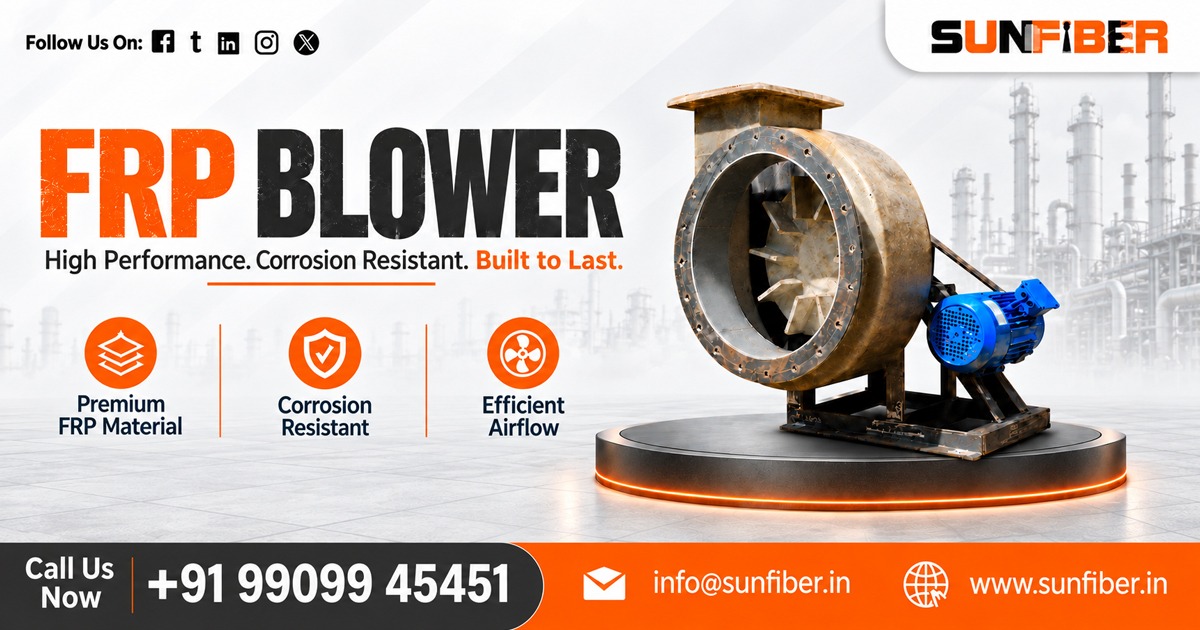
An FRP blower is designed to move air or process gases through ducts, scrubbers, ventilation lines, and related systems. Sunfiber lists HDPE, PP, FRP, and MS blower options within its engineering product range.
FRP construction is particularly relevant when the operating environment exposes equipment to:
- Corrosive fumes or chemical vapours
- Moist or humid air
- Industrial exhaust streams
- Chemical-process ventilation
- Scrubber exhaust systems
- Wastewater and treatment environments
The blower should be selected as part of the complete air-handling system rather than as an isolated motor-driven component.
Start With Airflow and Pressure, Not Just Blower Size
One of the common purchasing mistakes is selecting a blower based only on physical size or motor power.
Before contacting an FRP Blower Supplier In Jharkhand, prepare the operating information available from the plant:
- Required airflow or CFM
- Required static pressure
- Gas or air temperature
- Nature of fumes or vapours
- Duct length and approximate routing
- Number of bends and fittings
- Scrubber or filtration equipment connected to the blower
- Available installation space
- Electrical supply
Sunfiber’s published catalogue gives a broad product range, including 500–50,000 CFM airflow and 3–120 HP motor sizes. Actual selection should still be based on the system duty rather than choosing directly from a catalogue range.
How the Blower Works With a Scrubber or Duct System
In a typical industrial exhaust arrangement, the blower forms part of a larger air movement path.
1 – Exhaust Collection
Fumes or contaminated air are collected from the process through hoods, ducts, or equipment outlets.
2 – Air Movement
The blower impeller rotates and creates the pressure difference required to move the air through the system.
3 – Treatment or Filtration
Depending on the plant layout, the air may pass through a scrubber, filter, or another treatment unit.
4 – Discharge
The treated or conveyed air moves through the downstream ducting toward the designated outlet.
Sunfiber describes its blower construction as consisting of components such as the casing, impeller, and motor, with FRP intended for environments where chemical and moisture resistance can be important.
Material Compatibility Needs a Closer Look
For a chemical or process plant, buyers should provide:
- Chemical names
- Approximate concentration
- Operating temperature
- Gas composition where relevant
- Moisture level
- Continuous or intermittent operation
- Expected cleaning conditions
This information helps the supplier assess whether the proposed construction is appropriate for the application.
Installation Planning Before the Blower Arrives
A well-selected blower can still create operating problems if the site layout is not prepared properly.
Before installation, verify:
- Adequate space around the blower for inspection and servicing.
- Suitable support or mounting arrangements.
- Correct alignment with connected ducting.
- Accessible electrical connections.
- Proper inlet and outlet routing.
- Adequate clearance around moving equipment.
- Easy access for future maintenance.
- Compatibility between connected ducts, scrubbers, dampers, and the blower.
Avoid forcing duct connections into position because this can place unwanted mechanical stress on the equipment.
Routine Checks That Help Prevent Avoidable Downtime
FRP blowers still require routine inspection even when the casing itself is resistant to corrosion.
A practical maintenance checklist includes:
- Inspecting the casing for visible damage
- Checking impeller condition
- Observing unusual vibration or noise
- Checking fasteners and mounting arrangements
- Inspecting duct connections
- Checking motor and electrical connections through qualified personnel
- Looking for abnormal temperature or operating changes
- Keeping the surrounding area clean
- Reviewing wear or replacement requirements
Maintenance frequency should follow the manufacturer’s recommendations and the actual operating environment.
Troubleshooting Starts With the Operating Symptoms
| Common Issue | Possible Cause | Practical Check |
| Low airflow | Duct restriction or unsuitable operating condition | Check duct path, dampers and system resistance |
| Excessive vibration | Alignment, mounting or rotating-component issue | Stop operation safely and arrange inspection |
| Unusual noise | Mechanical or airflow-related problem | Check for abnormal operating sounds and inspect safely |
| Motor overload | System resistance or electrical issue | Verify operating conditions and have qualified personnel inspect |
| Reduced system performance | Fouling, blockage or changed process conditions | Inspect accessible ducts and connected equipment |
What Buyers Should Confirm Before Ordering
A supplier discussion becomes more useful when the requirement is documented clearly. Ask for confirmation of:
- Airflow requirement
- Static pressure requirement
- Blower construction and material
- Operating temperature
- Motor details
- Inlet and outlet dimensions
- Installation arrangement
- Connected equipment requirements
- Testing or inspection details
- Documentation supplied with the equipment
- Spare-part availability
- Installation or commissioning assistance
Do not compare quotations on price alone. A blower with a different duty point, material construction, or motor arrangement may not be directly comparable.
Services
- Application-based blower requirement assessment
- Airflow, pressure and configuration guidance
- Manufacturing and project coordination
- Installation, commissioning and after-sales technical assistance
Location
An FRP Blower Supplier In Jharkhand can support requirements across the state’s chemical, steel, mining, engineering, power and manufacturing belt, including Ranchi, Jamshedpur, Bokaro, Dhanbad, Deoghar, Hazaribagh, Ramgarh, Giridih, Dumka, Adityapur, Chandil, Kandra, Gamharia, Sindri, Patratu, Koderma, Lohardaga, Chaibasa, Sahibganj, Pakur, Garhwa, Medininagar, Gumla and Saraikela.
Industrial Support From Sunfiber
Sunfiber manufactures and supplies industrial products including HDPE, PP, FRP and MS blowers. Its published product range also covers tanks, reactors, scrubbers, vacuum receiver tanks, ducts, hoods, pumps and other fabricated industrial products.
For buyers in Jharkhand, requirement discussions can be coordinated with Sunfiber through its website, sunfiber.in, with manufacturing support from Ahmedabad, Gujarat, India. The company can assist with discussing the process requirement, equipment configuration, project planning and technical support.
FAQs
Q: What information is required to select an FRP blower?
A: Airflow, static pressure, temperature, gas composition, chemical exposure, duct arrangement and connected equipment are key inputs. Installation space and electrical requirements should also be discussed.
Q: What should be checked before installing the blower?
A: Confirm mounting arrangements, duct alignment, inlet and outlet connections, electrical supply, service clearance and access for inspection before commissioning.
Q: How should an FRP blower be maintained?
A: Regularly inspect the casing, impeller, mounting, duct connections, motor and operating condition. The maintenance schedule should follow the supplier’s recommendations and plant conditions.
Conclusion
Selecting an FRP blower for a Jharkhand industrial plant requires more than comparing motor power or equipment price. Airflow, pressure, chemical exposure, temperature, duct layout and maintenance access should be evaluated together. Sunfiber provides manufacturing support from Ahmedabad, Gujarat, India for industrial blower requirements and project discussions.
Contact Sunfiber to discuss your airflow requirement, application conditions, blower configuration, installation planning, and technical support needs.
Phone: +91 99099 45451
Email: info@sunfiber.in
Feel free to contact us for more information and inquiries.
View Product: Click Here