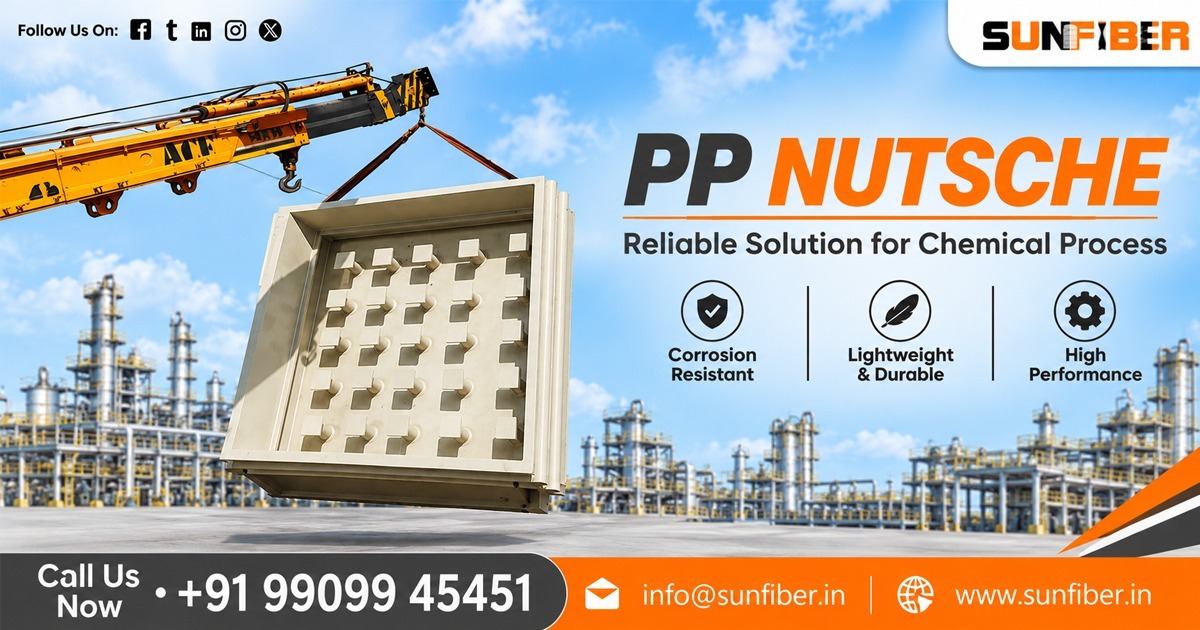
Industrial processes involving chemical solutions, pharmaceutical materials, and specialty products often require controlled solid-liquid separation. A PP Nutsche Filter for Efficient Solid-Liquid Separation helps manage filtration requirements, while Sunfiber provides manufacturing support from Ahmedabad, Gujarat, India.
Understanding the Role of a PP Nutsche Filter in Industrial Processing
A PP (Polypropylene) Nutsche Filter is an industrial filtration system designed to separate solid particles from liquids using a filtration medium and controlled pressure or vacuum, depending on the equipment configuration.
It is used when industries need to collect filtered solids while allowing the liquid portion to pass through the filter medium.
In industrial production, filtration requirements can vary according to the material being processed. Conventional filtration arrangements may create challenges related to material handling, filtration consistency, and product recovery.
A PP Nutsche Filter for Efficient Solid-Liquid Separation can support processes where polypropylene construction is suitable for the chemicals and operating conditions involved.
Industries may consider this equipment for:
- Chemical processing and intermediate production.
- Pharmaceutical manufacturing processes.
- Specialty chemical filtration.
- Pigment and dye processing.
- Fine chemical and industrial material handling.
What Should Buyers Evaluate Before Selecting a Filtration System?
Selecting filtration equipment requires more than checking its physical dimensions. Buyers should understand the characteristics of the material and the expected production requirements.
Important selection factors include:
- Batch Capacity: Determine the quantity of slurry that needs to be processed in each cycle.
- Chemical Compatibility: Check whether polypropylene is suitable for the liquid, solids, temperature, and concentration involved.
- Filtration Area: Select an appropriate filtration surface according to the required throughput and filtration characteristics.
- Particle Size: Understand the size and nature of solid particles to select a suitable filter cloth or medium.
- Operating Pressure: Confirm whether the process requires vacuum filtration, pressure filtration, or another arrangement.
- Discharge Arrangement: Consider how the filtered cake will be removed from the equipment.
- Available Space: Evaluate the installation area, operating clearance, and accessibility for cleaning.
- Maintenance Requirements: Check access to filter media, seals, and other components requiring periodic inspection.
A clear process requirement sheet helps buyers communicate their actual needs to the equipment supplier.
How the PP Nutsche Filtration Cycle Handles Slurry
Understanding the operating sequence helps production teams evaluate whether the equipment fits their existing process.
Step 1: Slurry Feeding
The mixture of liquid and suspended solid particles is introduced into the filtration vessel according to the equipment’s operating arrangement.
Step 2: Solid-Liquid Separation
A filter medium retains the solid particles while the liquid passes through it. The filtration process may use vacuum or pressure, depending on the system design.
Step 3: Filter Cake Formation
As filtration continues, retained particles collect on the filter medium and form a solid layer known as filter cake.
Step 4: Cake Washing and Drying
Where required by the process, the collected cake can undergo washing to remove residual liquid or impurities. Further drying may also be possible depending on the equipment configuration.
Step 5: Solid Material Discharge
The filtered material is removed using the provided discharge arrangement. The vessel and filter medium can then be prepared for the next batch.
The actual operating sequence depends on the process material, equipment configuration, and production requirements.
Quality Checks That Matter Before Purchasing PP Filtration Equipment
Before ordering industrial filtration equipment, buyers should review its construction and process suitability.
Consider checking the following:
| Inspection Area | What to Verify |
| Polypropylene Construction | Material suitability and construction quality |
| Vessel Dimensions | Diameter, height, and available filtration area |
| Filter Medium | Cloth compatibility and particle retention requirements |
| Sealing Arrangement | Proper sealing and leakage prevention |
| Operating Conditions | Pressure, vacuum, and temperature suitability |
| Discharge System | Accessibility and ease of material removal |
| Cleaning Access | Practical arrangements for cleaning and inspection |
| Documentation | Equipment drawings and operating details |
| Spare Parts | Availability of replacement filter media and components |
Buyers should also clarify the expected filtration performance using actual process data or suitable filtration trials wherever necessary.
Customizing Equipment Around Your Production Process
Filtration requirements are not identical across industries. Two production facilities may process different materials even when both require similar filtration equipment.
Before finalizing a machine configuration, discuss:
- Required batch volume and filtration area.
- Chemical concentration and slurry characteristics.
- Operating temperature and pressure conditions.
- Filter cloth type and filtration requirements.
- Cake washing and discharge arrangements.
- Installation layout and available utilities.
- Cleaning procedures and batch changeover requirements.
The final equipment configuration should be confirmed against the actual process conditions. Buyers should also verify which design and customization options are available from the manufacturer.
SERVICES
- Filtration Requirement Assessment: Understanding slurry characteristics, material compatibility, and production requirements.
- Equipment Selection Assistance: Evaluating suitable filtration capacity and equipment configuration.
- Installation Planning Support: Reviewing equipment dimensions, site conditions, and process connections.
- Technical and Maintenance Guidance: Providing relevant operating information and guidance for routine equipment inspection.
Location: Industrial Filtration Requirements Across Gujarat
Chemical, pharmaceutical, textile, dye, and specialty manufacturing businesses across Gujarat may require suitable solid-liquid separation equipment for their production processes. Sunfiber provides manufacturing support from Ahmedabad, Gujarat, India, serving industrial requirements across Ahmedabad, Surat, Vadodara, Rajkot, Gandhinagar, Bharuch, Ankleshwar, Vapi, Valsad, Ankleshwar GIDC, Dahej, Halol, Sanand, Changodar, Naroda, Vatva, Odhav, Kalol, Mehsana, Morbi, Jamnagar, Bhavnagar, and Kutch.
How Sunfiber Supports Industrial Filtration Requirements
Choosing suitable filtration equipment requires an understanding of the material, production process, and operating environment.
Sunfiber supports industrial customers in evaluating PP filtration requirements and identifying suitable equipment considerations for their applications.
Customers can discuss:
- Filtration requirements and process conditions.
- Equipment capacity and configuration considerations.
- Material compatibility and filtration arrangements.
- Technical requirements related to equipment selection.
With manufacturing support from Ahmedabad, Gujarat, India, Sunfiber aims to address relevant industrial requirements through product-related assistance and technical coordination.
Visit the official website: https://sunfiber.in/
Frequently Asked Questions (FAQs)
Q1: What is a PP Nutsche Filter used for?
A: It is used to separate suspended solid particles from liquids in industrial processes. It can also support filter cake collection and washing, depending on its configuration.
Q2: Is polypropylene suitable for chemical filtration?
A: Polypropylene can be suitable for several chemical applications. However, compatibility depends on the specific chemical, concentration, temperature, and operating conditions.
Q3: How do I determine the required filtration capacity?
A: Consider the batch volume, slurry concentration, particle characteristics, filtration time, and required production output before selecting equipment capacity.
Q4: What maintenance does a PP Nutsche Filter require?
A: Routine maintenance generally includes inspecting the filter cloth, checking seals and connections, cleaning product-contact surfaces, and examining the discharge arrangement.
Conclusion
Selecting the right filtration equipment requires careful evaluation of slurry properties, chemical compatibility, filtration capacity, and operating conditions. A PP Nutsche Filter for Efficient Solid-Liquid Separation can support suitable industrial processes. Sunfiber provides manufacturing support from Ahmedabad, Gujarat, India, for relevant equipment requirements.
Looking for suitable PP filtration equipment for your production process? Contact Sunfiber through https://sunfiber.in/ to discuss your filtration requirements and equipment selection.
Phone: +91 99099 45451
Email: info@sunfiber.in
Feel free to contact us for more information and inquiries.